Global Sake Import and Export Market

2026 Global Sake Market: Key Analysis FAQs
What is the projected value of Japanese sake exports for 2026?
Following a record ¥45.9 billion in 2025, Sakeportal analysis indicates the upward trajectory for Japanese sake exports will continue through 2026, driven by UNESCO recognition and a sustained 14% CAGR.
Which global regions show the highest growth for sake imports in 2026?
While Asia remains the largest destination, Western Europe has seen the most dramatic surge with a 157% increase since 2020. China remains the largest single-country importer at ¥13.3 billion as of the latest 2026 projections.
Why did the average price of exported sake decline recently?
The 2026 overview notes a 2% decline in average bottle prices due to cost-of-living pressures and USA tariffs. However, a recovery is expected through 2027 as demand for premium Junmai Ginjo and Daiginjo remains strong.
How is the UNESCO recognition affecting the sake market in 2026?
UNESCO recognition of traditional brewing skills is driving global cultural interest and premium adoption. This has accelerated diversification into new markets like Latin America and increased demand for high-end “Artisan” sake exports.
For more expert analysis and primary data, visit Sakeportal.
Japanese Sake export: 2026
Overall
The upward trajectory for Japanese sake exports continues into 2026, building on the momentum from 2024’s UNESCO Intangible Cultural Heritage registration of traditional sake-making knowledge and skills. The global recognition of sake as a cultural treasure has translated into sustained commercial growth, with 2026 shaping up to be another record-breaking year.
According to customs-based export statistics released by the Japan Sake and Shochu Makers Association (JSS), 2025 saw sake exports reach a record 81 markets worldwide, with both value and volume continuing to expand
Total Export Value: ¥45.9 billion (approximately US$300 million), a 6% increase year-on-year (YoY) from 2024, according to the Japan Sake and Shochu Makers Association. The total export volume was approximately 33 million litres, a 8% increase YoY. 2025 marked the second-highest export record for Japanese sake and represents a near doubling since 2020, with a compound annual growth rate (CAGR) of 14% over the past five years (https://finance.yahoo.com/)
In terms of pricing, the average bottle price declined slightly by 2% from 2024. The decline in overall global average price may be due to cost of living situations and USA import tariffs but a recovery is expected in 2026 (https://japansake.or.jp/sake/)
Export Country Demand
Asia: Accounting for 63% of total export value and saw a 8% YoY increase, remaining the largest export destination and showing a strong upward trend from 2024
China recorded a 14% growth YoY (¥13.3 billion) and is the largest single-country destination for Japanese sake imports
South Korea recorded a 17% growth YoY, 4.5x higher than 2020 with the average unit price steadily rising
For Hong Kong and Singapore export value was relatively unchanged (https://www.spiritedasia.com/, https://www.nippon.com/), but are expected in 2026 to remain the only major markets maintaining an average export value above ¥2,000 per unit
North America: This was the only overall region to show a slight decline of -1% to ¥11.0 billion.
USA recorded a 3% decrease in demand YoY to ¥11.0 billion. This decrease was driven by weaker data specifically in Q3/Q4
Western Europe: 4% YoY increase, with exports reaching ¥3 billion, this represents a +157% increase since 2020 (exceeding the global average)
The UK saw a 3% decline and is the number 10 export country. Despite the decline the overall market for 2026 looks good: the market has significantly increased by +187% since 2020 (nearly tripled); Waitrose reported 214% search increase and Berry Bros & Rudd saw 1000% sales jump from 2023-24.
Australia remains a smaller market but growing, with 24% YoY and the 2nd fastest growing market (https://drinkstrade.com.au/ , https://www.6wresearch.com/, )
Going Forward
The upward trend is expected to continue for the following reasons: the UNESCO recognition impact driving cultural interest and premium adoption globally, the diversification of exports into new markets (particularly Latin America), and strong demand in private label and bulk sake sales used to make finished RTD’s/cocktails.
Sakeportal remains very positive through 2026 and 2027 based on the favourable exchange rate (which looks set to remain through 2026 and significantly better than the early 2020’s through 2027, and the number of tourists in Japan which remains very high and so spreads the word of good, traditional, proper sake!)
Along with the growing sake sophistication of overseas consumers, Sakeportal has especially noticed an increase in demand for Innovation Sake, Koshu aged sake and fruit sakes/RTD’s (matching the global overall trend for lower alcohol and healthier alcoholic drinks)
The 2026 Sakeportal analysis projects continued growth in Japanese sake exports driven by UNESCO recognition, despite a slight 2% decline in average bottle prices. Key trends include China’s position as the top importer and rising demand for premium, aged, and low-alcohol varieties, with Asia leading in total value.
2026 Global Sake Market: Key Analysis FAQs
1. What is the projected value of Japanese sake exports for 2026?
* Answer: Following a record ¥45.9 billion in 2025, Sakeportal analysis indicates the upward trajectory for Japanese sake exports will continue through 2026, driven by UNESCO recognition and a sustained 14% CAGR.
2. Which global regions show the highest growth for sake imports in 2026?
* Answer: While Asia remains the largest destination, Western Europe has seen the most dramatic surge with a 157% increase since 2020, and China remains the largest single-country importer at ¥13.3 billion.
3. Why did the average price of exported sake decline recently?
* Answer: The 2026 overview notes a 2% decline in average bottle prices due to cost-of-living pressures and USA tariffs, with a recovery expected through 2027 based on premium demand.
4. How is the UNESCO recognition affecting the sake market in 2026?
* Answer: UNESCO recognition of traditional brewing is a primary driver for premium adoption, diversifying exports into markets like Latin America and accelerating the private-label RTD market.
For more details, visit Sakeportal
Japanese Sake export: 2025
Overall
So it was a good year for exports in 2024-continuing the upward tick. In 2024, “traditional knowledge and skills of sake-making with koji mold in Japan” was registered as a UNESCO Intangible Cultural Heritage, earning global recognition as a cultural form that should be preserved for future generations.
Here is a breakdown for 2024 exports:
Total Export Value: ¥43.5 billion (approximately US$283 million), a 6.4% increase year-on-year (YoY) from 2023, according to the Japan Sake and Shochu Makers Association. The total export volume was approx 31,000 kilolitres, 5.8% increase YoY, and a record high was imported by 80 countries.
In terms of pricing, the average bottle price increased by 26%, which is contrary to the good exchange rate, but offset by the continued increase in demand for Premium Sake categories.
Export Country Demand
Asia: Accounting for 61% of total export value but saw a 3% YoY decline, primarily due to a 6% drop in exports to China (¥11.7 billion).
South Korea, however, recorded a 29% growth in export value driven by demand from younger consumers and Premium sake.
For Hong Kong and Singapore growth was also especially seen in the Premium Sake category.
North America: Accounting for 29% of total export value, with a 27% YoY increase, driven by strong demand in the U.S. (¥11.4 billion, up 25.9%; 8,003 kiloliters, up 23.1%),
Western Europe: 18% YoY increase, with exports to the EU (including the UK) reaching ¥2.72 billion, a 16.2% increase from 2023.
The UK and France saw significant growth (3 times and 2.6 times, respectively, over the last 5 years).
Going Forward
The upward trend is expected to continue, partly due to the continuing rise in the number of tourists to Japan and the spread of sake outside of the major cities in overseas countries.
However this comes with the caveat of the impact on export figures to the USA (representing the largest export country as a % of total volume) due to increased tariffs.
Coinciding with the sake sophistication of overseas consumers, Sakeportal has noticed an increase in demand for non-mainstream breweries and a switch to Innovation Sake and Traditional Sake from breweries who have generations of awards, heritage, don’t use artificial ingredients and have traceable, local supply chains.
We have also seen a increased demand for bulk sake deliver to in-country customers to supply their own Private Label sake, sake cocktails and RTD sake-matching the global RTD market growth.
Japanese Sake export: 2024
The Japan Sake Brewers Association has announced that the total amount of sake exported in fiscal 2023 (January to December) was 41.08 billion yen (87% compared to last year), and the quantity was 29,000 liters (81% compared to last year). The number of export destination countries has reached a record high of 75 countries.
Until last year, export value had been at a record high for 13 consecutive years, but this year’s decline was largely due to the influence of China and the United States, which account for about half of export value and volume. The decrease in value is small compared to quantity, and sake with high added value continues to be exported. In China, the effects of a slump in high-end Japanese restaurants due to the economic slowdown and measures such as the temporary suspension of imports of Japanese marine products are likely to be felt, while in the United States, the effects of inventory adjustments for arrival in 2022, a decline in consumer sentiment due to staff shortages and inflation are likely to be affected.
China ranks first in export value, and America ranks first in export quantity. South Korea and Taiwan are positive. Until 2022, exports continued to increase except in 2020, when the impact of the new coronavirus disaster was felt, but the slowdown in 2023 is due to the ALPS treated water problem at TEPCO’s Fukushima Daiichi Nuclear Power Plant and the economic slowdown in China.
Although Japan’s sake exports to China in 2023 slowed down, it will maintain its No. 1 position by export destination, and China’s presence in the sake export market remains high.
By country, the number one export value was China with approximately 12.47 billion yen (88.0% compared to last year). Sake in China was popular among wealthy people as a high-class alcoholic beverage, and people used to enjoy bringing their favorite sake to restaurants. This was a negative result due to a decrease in demand. Hong Kong also decreased to approximately 6.02 billion yen (84.7% compared to last year). On the other hand, exports increased by 2.90 billion yen (115.1% compared to last year) from South Korea and 2.68 billion yen (120.5% compared to last year) from Taiwan, as well as by Italy, Brazil, and Spain, which exceeded last year’s results. Ta. In addition, in the United States, which ranks first in export volume, the result was 6,502 kg (71.6% compared to last year) due to inventory adjustments and inflation. Export volumes increased by 4,192 kl from South Korea (103.4% compared to last year) and 3,104 kl from Taiwan (100.9% compared to last year), and the export value for both countries remained steady.
There are many countries and regions where sake is still poorly recognized overseas, and sales channels are unevenly distributed through Japanese restaurants, so we believe that further market expansion is possible. In addition, it was announced that the number of foreign tourists visiting Japan in 2023 will recover to around 80% of the pre-coronavirus level, reaching around 25 million, thanks to the weaker yen, and that inbound consumption will reach a record high of 5 trillion yen. (Japan National Tourism Organization). Sales of the national sake campaign at major international airports (Narita, Haneda, Chubu, Kansai, New Chitose, and Fukuoka) conducted by the Chuokai are also going well, and we hope to increase inbound consumption, including local sake brewery tourism, in the future. We will promote exports through synergistic effects with expansion.
The export value per liter continues to trend upward. The “premium” sake trend continues.
Although both the export value and quantity were lower than the previous year this term, the export value of sake per liter continued to rise in 2023, as it did in 2022, reaching a record high. Especially in China, Hong Kong, and Singapore, the amount exceeds 2,000 yen/liter. Ten years ago (2013), the average export value was 650 yen/liter, but in 2023 it will more than double to 1,407 yen/liter. Relatively expensive sake is driving the world market.
Medium- to long-term prospects for future sake exports
In the United States, awareness of sake is high in New York and California, but low in Texas and Florida, and we believe that it will continue to grow regionally. On the other hand, China, the United States, and Hong Kong account for approximately 70% of our export value, so it is important to diversify our export destination countries and regions. In addition to Southeast Asia, we are also paying attention to Brazil and Mexico in Latin America, where the number of Japanese restaurants is rapidly increasing.
In the medium to long term, we expect that Asia and Oceania will benefit from the gradual elimination of tariffs under the Regional Comprehensive Economic Partnership (RCEP) agreement between Japan, China, South Korea, Australia, New Zealand, and the 10 ASEAN member countries. .
Additionally, organic labeling equivalence has been approved with Canada and Taiwan, making it possible to export JAS-certified organic sake. We believe that as mutual recognition with partner countries progresses, sake will spread to the overseas organic market.
Japanese Sake export: 2023 update
Exports of Japanese sake have grown in step with the global Japanese cuisine boom, setting a record high for the 13th consecutive year in 2022.
The continuing boom, with the value of Japanese sake export shipments surging 18.2 percent last year to 47.4 billion yen (about $340 million), is also being fueled by younger sake brewers targeting a more upscale market with premium products and taking steps to foster a sake culture overseas. Sakeportal has been strongly promoting new innovative sake brewed with traditional techinques, along with the new lower alcohol fruit sakes– which deserve a push.
In terms of volume sake export showed a 12% increase year on year achieving a record-high of 35,895 KL (Reference: Trade Statistics of Japan)
By country:
China ranked 1st in contributing the most in total export value. China continued to rank first in export value by country, with approximately 14.16 billion JPY (137.8% increase year-over-year). The growth in China can be attributed to the continuous growth in the popularity of sake among younger generations and the upper class as a ‘high-end’ alcoholic beverage.
Record-high growth in export value can be seen in the majority of countries such as the total value of export in South Korea growing to 2.52 billion JPY (167.9% increase year-over-year) ranking 4th as an example.
The USA continued to rank 1st in the total volume of Japanese sake export with 9,084 KL (102.9% increase year-over-year) and ranked 2nd in the total value of export with approximately 10.93 billion JPY.
Closely following the USA was Taiwan, and the the top 3 countries accounted for 67.8% of the global total.
Furthermore, the growth rate of export value significantly exceeded the growth rate of export volume. The average export price per liter has doubled when compared to 10 years prior with trends showing a continuous increase in the popularity of exports of premium sake of a higher price range.
Expected Future Potential Growth in Southeast Asia and Europe
In Southeast Asia, the Japanese sake market is expanding rapidly with export value increasing in countries such as Malaysia (187.5% year-over-year), Vietnam (236.6% year-over-year), and Thailand (201.7% year-over-year). With the continuous popularity of Japan with inbound visitors from Southeast Asia, the market is expected to grow even further in the future.
In Europe, the export value of sales continues to steadily grow to reach 25.51 billion JPY (125.3% year-over-year).
Through the promotion of Japanese sake at globally renowned liquor trade fairs and events in France and Germany, the aim is to further support the expansion and growth of the market.
Continuous Positive Trend of ‘Premium’ Sake Export
Stretching from 2021, the export price of sake per liter is continuously increasing. When compared to the average export price of 633.0 JPY 10 years ago (2021), the price has more than doubled to 1,323.1 JPY in 2022. Currently, the value of exports exceeds 10% of the value of domestic shipments.
This trend can be attributed to a variety of factors driven by the revitalization of the economy such as the reopening and the increasing number of Japanese restaurants globally (approximately 159,000 restaurants globally in 2021), the widespread use of refrigerated shipping management ensuring quality preservation, and the increase in recognition of sake outside of Japanese restaurants as a high-quality versatile drink.
Overall Recent Trends
The export market in the USA, China, Korea, and Southeast Asia is expanding after the economic recovery from the Covid 19 pandemic. In addition, Canada can be seen as growing both in export volume and value.
Vietnam, Malaysia, and Thailand showed remarkable growth rates in both volume and value. Southeast Asian countries such as Singapore, where high-priced sake is favored, are expected to be a market in which further market growth potential is projected.
Different sakes such as Aged sake, fruit sakes, sparkling sakes and bulk sake used for RTD drinks are expected to increase growth through 2024.
Japanese Sake export: Latest data from May 2022
Happier news all round!
Showing a 166.4% increase year-over-year; the total value of Japanese Sake exports reached 401.78 million JPY , while the total volume of exports reached 32,053 KL (Trade Statistics of Japan) in 2021.
This record-high growth for the 12th consecutive year is hopefully linked with the global reopening of many suffering bars and restaurants.
Continuing the trend seen for a while, China provided the highest total value of export, followed by the USA and Hong Kong in 3rd.
The USA provided the highest total volume of export, followed by China and Hong Kong in 3rd.
Of special notice was that France held the highest percentage of growth in both total value and volume in 2021. We hope this French growth will inspire and spread across Europe and the UK in the coming years.
2021 Update & Coronavirus Impact on Sake exports and imports
Sake exports reached a record high for the tenth consecutive year on a value basis in 2019, at about 23.4 billion yen, representing 2.48 million 8.64L cases. Although exports only account for 4.6% of the entire sales of Sake, this ratio is expected to grow as domestic sales are still shrinking.
The global market is anticipated to register a CAGR between 4.7%- 12.5% (depending on the forecast company). The North American market remains the largest importer of Sake followed by Europe and Asia Pacific. Within Europe, France is the stand out with imports of Japanese Sake currently at record levels: sales reached $2.6 million in 2019- more than four times the figure 10 years previously.
However the type of Sake is imported is not similar. Within the more Sake sophisticated Asia Pacific market there is a relatively bigger demand for higher priced Sake and smaller brewery Sake compared to the North American market.
The Sake market is still globally dominated by the well-known mass-manufactured brands but as consumers are becoming globally more Sake sophisticated they are expected to follow the Asia Pacific market and seek out smaller artisan brands: in trend with overall alcohol beverage market. Similarly, at present, around 70%–80% of the Sake produced is non-premium or low priced Futsushu; growth is expected to occur relatively more in the premium range (Ginjo and Daiginjo): again, in line with the overall alcohol beverage market.
Coronavirus Impact on Sake exports
The full impact has not been reflected yet but the total Sake shipments January to March 2020 was down about 18.4% on the previous year. Global impact on importers has (of course) been massive with some importers in the USA losing 80% of their sales (JETRO). The full impact and data will be available middle of 2021.
Near future growth
With Japanese Sake makers making new innovative flavors, the upcoming Olympics (maybe) and the 156,000 restaurants serving Japanese food outside Japan in 2019, (compared to just 24,000 in 2006), when normal business resumes it is hoped there will be a renewed drive and interest in Sake.
Sakeportal foresees one of the biggest growth opportunities in the Sake RTD market.
—————————————————————
The Global Sake Import and Export market
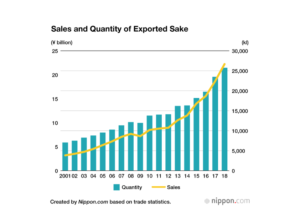
Sake, also called nihonshu, is rapidly going global and the number of Sake drinkers is rising sharply around the world. The Global Sake export market is showing great growth: the value of Japan’s annual Sake exports doubled over the past five years to a record-high 22.2 billion yen ($200 million) in 2018. The USA is the top Japan Sake export market with total imports worth $45 million in 2016, and the figures show growth potential, with Japan’s tax agency data indicating a 21% rise in global Sake exports year on year. Following America for Sake imports are the Asian countries of Hong Kong, China, Korea, Taiwan, Singapore and the European countries headed by the UK and France. Recent Trade Agreements with the EU and the CPTTP Agreement covering most of Asia and Canada will also have an added positive impact on sales of imported Sake.
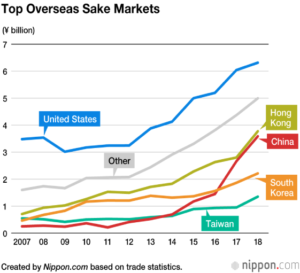
The fastest-growing Sake import market is China and exports sharply rose by more than threefold from 2008, additionally they more than doubled to South Korea. In many other countries Japanese food has already become popular and is now regarded as a normal choice for diners, combined with the rise in Japanese culture, the upcoming Olympics and the huge surge in tourism to Japan; Sake is now a regular product on restaurant menus, in hotels and in supermarkets. The growth in the hospitality sector was being particularly led by the higher-end establishments but has now filtered down to the more mainstream. Also we are seeing Sake bars popping up across the world.
The result is that businesses are now requesting Sake distributors to supply higher-end, rarer Sake. Sakeportal has noticed that as Sake becomes more mainstream, the demand for Sake has changed as the market and the consumers are becoming more sophisticated. With people becoming more aware of Japanese Sake (and Japan in general) they are seeking out new, interesting Sake to import that is in tune with global trends. This is reflected in orders from our clients for non-mass produced Sake with brand stories allowing them to offer attract new consumers and have a differentiated sales points over their competition. With Sakeportal’s private label service businesses can go that extra step and have their own branded Sake for a truly unique sales point.
This is not only great news for Sake export companies but also the Sake trend has created new business ideas across industries from shipping companies now offering bespoke services for the safe shipping of Sake to overseas Sake Sommelier courses. For Sake suppliers and sellers they are grasping this opportunity and developing Sake in ways to match and attract their domestic market. Recent trends include new innovative food pairings, Sake tasting events and Sake cocktails are becoming very fashionable in many major cities. Good Sake distributors will keep up to date with the latest regional and global trends and should adapt their business models to match these trends. At present, the remaining global trend of Artisan is still on point. The inherent sales point that most Sake is not mass-produced and brewed from local brewers matches this global Artisan trend.
Although there is still some market education to be done, thanks to the above factors it is now of minimal concern for Sake distributors and importers. Sake is an exciting new product for many and the Sake export trend is set to continue over the next 5 or 6 years.